CEO Kingsley Hall said: “Micro-X continues to engage closely with clinicians, emergency services and our partners including the Australian Stroke Alliance, to ensure that our device is designed as a simple and cost-effective solution to the problem of rapid stroke diagnosis.”
Reducing the time from stoke onset to treatment has been shown to hugely improve patient outcomes and reduce healthcare costs, particularly in rural and remote locations.
A CT scan (aka computerised tomography scan) is an imaging technique that involves a series of X-rays taken in quick succession around a patient plus computer technology that combines the X-ray images to create detailed cross-sectional 3D images of the inside of the body.
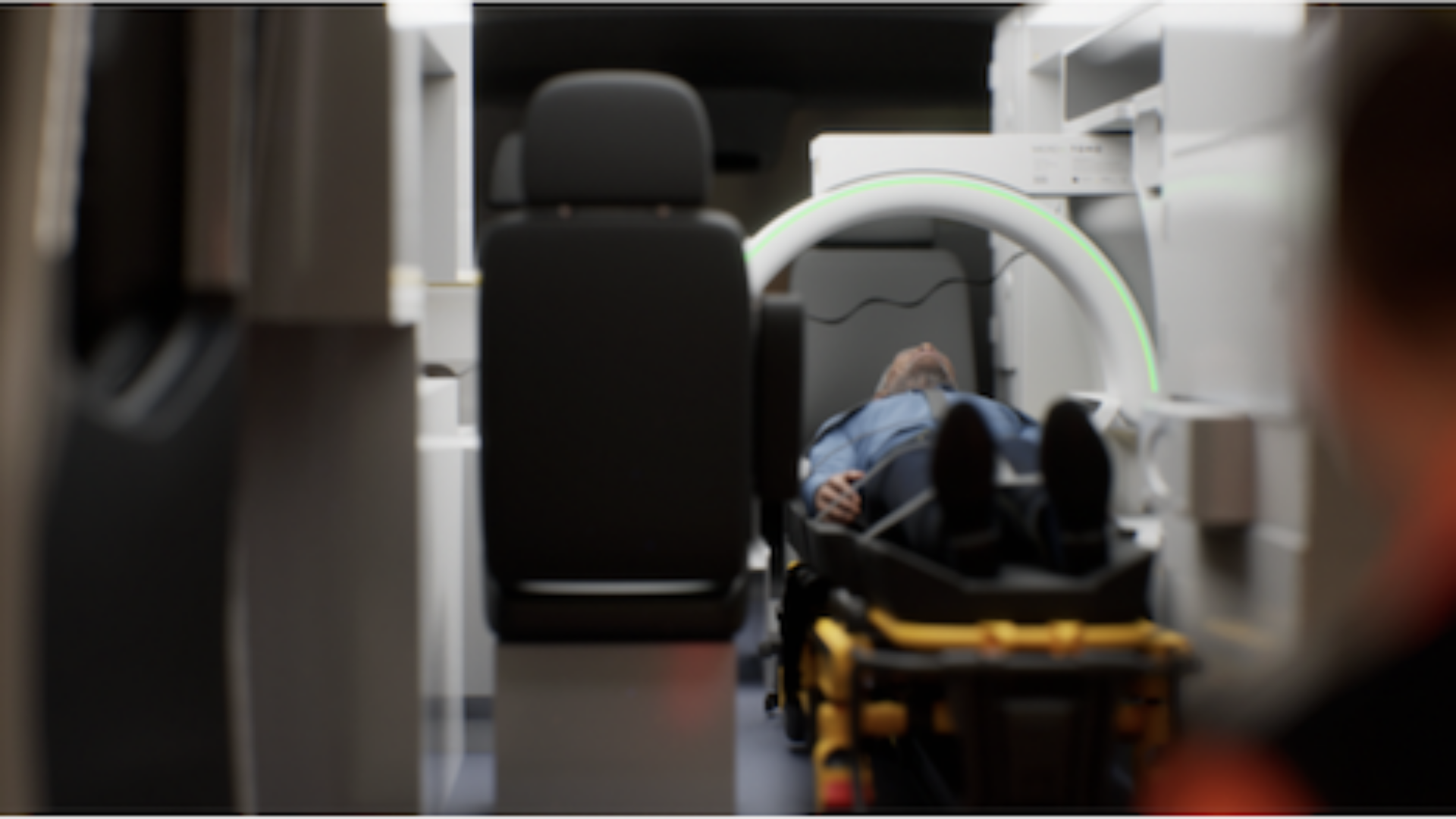
Paramedics attending to a stroke patient could use the scanner (which has been designed to be stored inside an existing space in conventional ambulances) to scan the patient’s brain in 8 seconds at any location – and then forward the image to clinicians for rapid assessment.
Designed in collaboration with Monash University, the CT scanner can be easily retrofitted into any ambulance.
“The clever design allows the entire scanner to stow neatly with simple reconfiguring of some stowage cabinetry, and no impact to the vehicle’s infrastructure. This should allow ease of integration into existing fleet vehicles at minimal cost,” explained Kingsley Hall.
Manufactured at its plant at the Tonsley Innovation District in Adelaide, Micro-X’s brain scanner comprises 21 mini X-ray tubes and is expected to weigh less than 70 kg compared to 500 kg for a conventional CT.
Micro-X plan to expand the scanner’s use beyond ambulances to ICUs, healthcare units and radiology clinics.
The project is funded by the Australian Government Department of Health and Aged Care Medical Research Future Fund and will occur over 5 years with the outcome being a clinically proven mobile head CT system ready for commercialisation.
________
The Electronic X-Ray Tube is leading the charge in a new era in X-ray technology, providing a faster and more precise system that offers a new realm of possibilities for X-ray performance and application and with the potential to revolutionise X-ray imaging across a number of industries.
Micro-X’s head CT scanner is one of a number of products the company has designed, taking advantage of the CNT X-ray.
The Micro-X team identified the need for a lighter, smaller X-ray tube to become a tool that could be used across industries to boost workflow and capability. The idea of using carbon nanotube technology was born – and the company created the world’s first carbon nanotube (CNT) based X-ray tube for medical applications.
Micro-X’s unique technology achieves both the high X-ray current and the stable X-ray output required for safe and effective medical imaging.
CNT X-rays are smaller and simpler compared to conventional X-ray tubes, and controlled by direct electronic voltage instead of the indirect thermionic control of conventional X-ray. These differences enable new imaging systems to be developed.
Since X-ray imaging was initially invented in 1895 by Dr Wilhelm Conrad Röntgen, the technology has remained largely unchanged – until now.
Read more 👉 HERE
This article was informed by AuManufacturing news and information from Micro-X’s website
Image source: Micro-X